
Coaching and Burnout in Healthcare Professionals: From Firefighting to Sustainable Practice
Burnout is now widely recognised as a serious occupational hazard in healthcare, yet it is also increasingly understood as a modifiable one. The World Health Organisation describes burnout as an occupational phenomenon arising from chronic workplace stress that has not been successfully managed, characterised by exhaustion, mental distance or cynicism about work, and reduced professional efficacy (WHO, 2019). In nursing and across healthcare professions, high workload, staffing shortages, emotionally demanding work and limited control over practice environments are strongly associated with burnout and its consequences for patient safety and quality of care (Dall’Ora et al., 2020; Hall et al., 2016; Jun et al., 2021; Li et al., 2024).
Alongside the concern, however, there is now a growing body of evidence pointing to practical, hopeful strategies for change. One of the most promising is coaching: a structured, forward-looking, strengths-based conversation that supports professionals to rediscover meaning, build resilience and take constructive action. This article explores how coaching fits within contemporary understandings of burnout and argues that, when combined with organisational reform, it is a powerful tool for both recognising and preventing burnout in healthcare staff.
Burnout as the backdrop: why coaching matters
Contemporary models conceptualise burnout as a triad of emotional exhaustion, depersonalisation (or cynicism) and reduced professional efficacy (Maslach and Leiter, 2016). Burnout arises when there is a persistent mismatch between job demands—such as workload, time pressure and emotional labour—and job resources, including autonomy, recognition, supportive leadership and cohesive teams. The Job Demands–Resources model makes clear that even highly committed, skilled professionals will struggle when demands chronically exceed resources.
In nursing in particular, reviews consistently show that burnout is linked to higher rates of adverse events, self-reported errors, lower patient satisfaction and impaired safety culture (Hall et al., 2016; Jun et al., 2021; Li et al., 2024). Burnout also affects staff themselves, contributing to depression, anxiety, sleep disturbance, reduced professional confidence and intentions to leave. Yet the same literature emphasises that burnout is not inevitable. It is shaped by organisations, and it can be mitigated by interventions that rebalance demands and resources, strengthen psychological capacities and restore a sense of meaning at work (Dall’Ora et al., 2020).
Within this wider picture, coaching offers a constructive, future-focused way to help healthcare professionals understand their own responses to stress, build on existing strengths and take active steps towards healthier, more sustainable ways of working.
What coaching looks like in healthcare
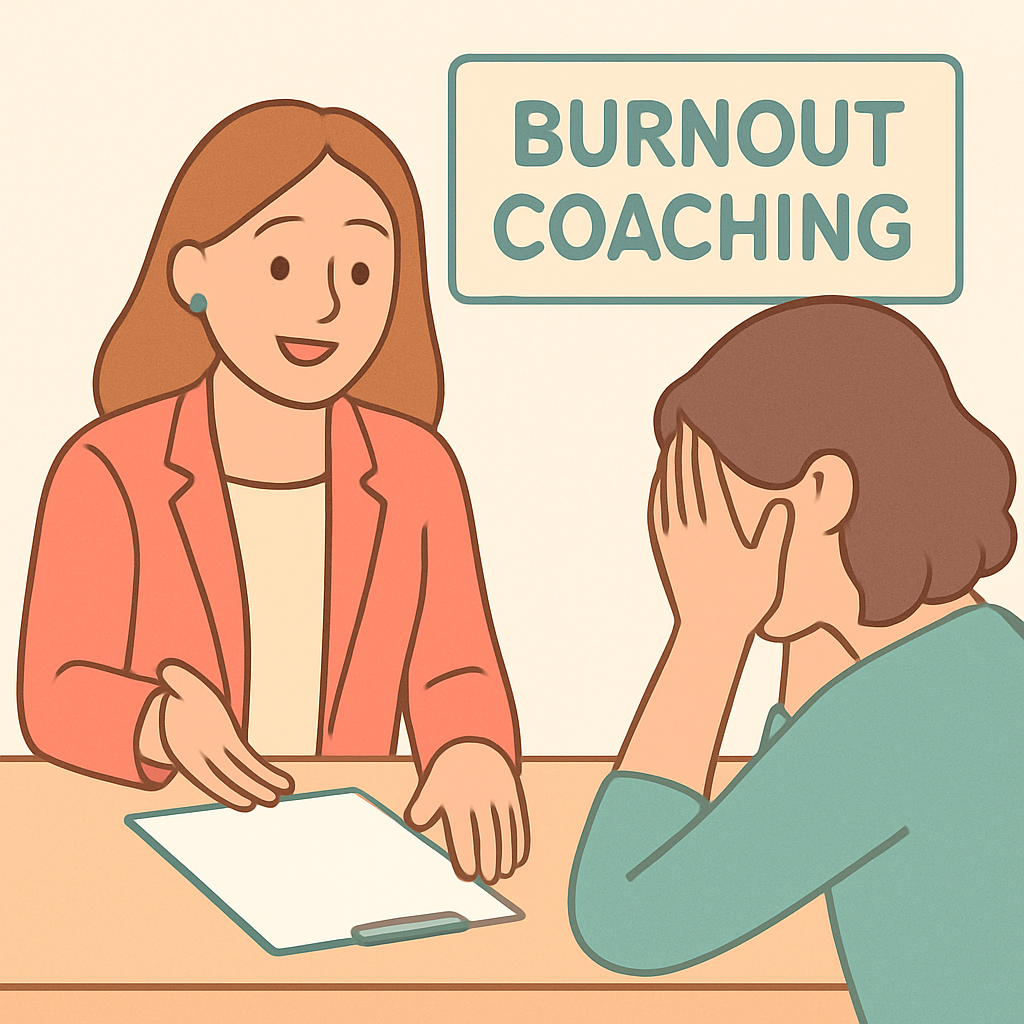
In the context of healthcare, coaching usually takes the form of a time-limited series of structured conversations, delivered on a one-to-one or small-group basis by a trained coach. The coach may be an external professional, a clinician with coach training or a peer who has been prepared for this role. Although models differ, most approaches share several core features.
First, coaching provides a confidential space for reflection. Clinicians can explore the pressures they experience, the stories they tell themselves about those pressures and the values that matter most to them in their work. This reflective element is especially important where staff are struggling with moral distress, repeated exposure to trauma or a sense of disconnection from their professional ideals.
Second, coaching is goal-focused and action-oriented. Rather than concentrating primarily on past difficulties, coaching helps staff identify practical changes they can make in areas such as boundary-setting, time management, communication with colleagues, or alignment between tasks and values. The emphasis is on what is possible, given current realities, which can feel particularly empowering in systems that may otherwise appear overwhelming.
Third, coaching is explicitly strengths-based. Coaches look for existing examples of resilience, effective coping and professional satisfaction, and help staff amplify these. This maps closely onto constructs such as psychological capital (hope, optimism, self-efficacy and resilience) and compassion satisfaction, both of which have been associated with lower burnout and better retention in nursing and other health professions.
Finally, coaching is usually framed not as treatment for illness but as professional development. For many clinicians this feels more acceptable than “therapy”, reducing stigma and encouraging earlier engagement—before distress becomes severe.
Evidence that coaching works: a hopeful picture
The strongest empirical evidence for coaching currently comes from studies with physicians, though the mechanisms are clearly applicable across professions.
A pilot randomised clinical trial by Dyrbye et al. (2019) involving 88 physicians demonstrated that six sessions of individual professional coaching over five months significantly reduced emotional exhaustion compared with controls, and improved overall burnout scores, quality of life and resilience. Importantly, the intervention was relatively brief and structured, suggesting that meaningful change does not require long-term, open-ended input.
Subsequent studies have developed this work further. Kiser et al. (2024) tested a peer coaching model in which physicians were coached by professionally trained colleagues. This randomised trial showed clinically meaningful reductions in burnout and improved wellbeing, indicating that coaching can be effectively delivered from within the workforce itself. Khalili et al. (2025) compared small-group professional coaching with one-to-one coaching and control conditions, finding that group coaching reduced burnout while individual coaching produced sustained benefits that persisted beyond the end of the programme. Together, these studies support the idea that coaching is both effective and flexible in format.
Although the research base in nursing and allied health professionals is smaller, it points in a similarly encouraging direction. Hines-Stellisch et al. (2024) describe a structured wellness coaching programme for emergency clinicians that led to improvements in burnout scores and reduced turnover intentions. Vogt et al. (2024), evaluating the Reboot coaching programme for critical care nurses in the UK, found increases in resilience and confidence in coping with stressful events, alongside reductions in burnout, depression and intention to leave. Franklin (2022) reports that resilience-focused coaching for behavioural health nurses produced measurable reductions in burnout and positive feedback from participants regarding coping and support.
Coaching also appears helpful in supporting healthy behaviours that indirectly reduce burnout risk. Nerek et al. (2024) show that a mixed-methods intervention combining feedback with health coaching successfully increased physical activity in nurses, supporting long-term behaviour change associated with better mental health. Pilot work on character-strengths-based coaching in healthcare workers suggests potential benefits for wellbeing and mindfulness (Bondre et al., 2024).
Systematic reviews and meta-analyses of interventions to improve wellbeing and reduce burnout among healthcare staff conclude that individual-level approaches such as coaching, mindfulness and resilience training are “probably effective”, producing small to moderate improvements in key outcomes (Cohen et al., 2023). While modest, these gains are encouraging given the complex, multi-factorial nature of burnout. They also signal that investing in staff development and psychological support is not merely “nice to have” but a meaningful component of workforce and safety strategies.
How coaching helps: mechanisms that matter for burnout
Coaching appears to work through several interlinked psychological and relational mechanisms. These mechanisms align closely with the factors known to influence burnout and resilience in healthcare staff.
One mechanism is the strengthening of psychological resources. Coaching frequently targets self-efficacy, optimism and hope, all of which are core components of psychological capital. Staff are supported to recognise what they can influence, identify small, achievable steps and reframe challenges in more constructive terms. Studies of nurse managers and other leaders have shown that higher psychological capital is associated with lower burnout and greater job satisfaction, suggesting that this is a valuable target for intervention.
Another important mechanism is the facilitation of reflective practice. Coaching offers a protected space in which clinicians can process difficult experiences, explore ethical tensions and reconnect with their reasons for entering the profession. Rather than focusing solely on problems, the conversation explores what gives work meaning, what “good care” looks like in context and how staff can align their daily practice more closely with their values. Participants in the Reboot programme, for example, described feeling more able to cope with critical incidents and less defined by them (Vogt et al., 2024).
A third mechanism involves reshaping stress mindset and self-care behaviours. Coaching conversations often encourage staff to distinguish between stress that is challenging but manageable and stress that is harmful and unsustainable. This distinction can help individuals recognise early warning signs of burnout and take action sooner. Health coaching models, such as those used in physical-activity interventions for nurses, translate insight into concrete plans around rest, movement, nutrition and recovery, which in turn support better emotional regulation and energy over time (Nerek et al., 2024).
Finally, coaching supports professional identity and connection. The relationship between coach and coachee, and in many cases between participants in group or peer-coaching formats, creates a sense of being heard, understood and not alone. Sharing stories, strategies and successes reinforces professional identity as capable, caring and resourceful rather than depleted or failing. Given growing evidence that strong professional identity protects against burnout and reduces turnover intentions, this relational dimension is particularly valuable.
The table below summarises these mechanisms and their relevance to burnout.
Focus of coaching | Likely impact on burnout-related factors |
Psychological capital (hope, efficacy, optimism, resilience) | Increased capacity to cope with demands; reduced emotional exhaustion and helplessness |
Reflective practice and meaning in work | Greater sense of purpose and coherence; reduced depersonalisation and moral distress |
Stress mindset and self-care behaviours | Earlier recognition of overload; healthier routines; lower risk of severe burnout |
Professional identity and connection | Stronger sense of belonging and competence; reduced isolation and intention to leave |
This combination of cognitive, emotional and relational change helps to explain why relatively brief coaching interventions can have disproportionate benefits for wellbeing and engagement.
Keeping perspective: coaching as a powerful tool, not the only answer
While the evidence for coaching is promising and increasingly robust, it is important to situate it within the broader context of burnout as an organisational phenomenon. Reviews of burnout in nursing emphasise that structural factors—such as unsafe staffing levels, excessive workload, poor leadership and misaligned values—are the primary drivers of burnout (Dall’Ora et al., 2020; Maslach and Leiter, 2016). Coaching, no matter how skilfully delivered, cannot compensate for chronically unsafe conditions.
There is also a risk that if coaching is used in isolation, it may inadvertently signal that burnout is mainly a personal problem to be solved by increased resilience. This runs counter to the evidence and can feel invalidating for staff who are working in objectively challenging circumstances. To avoid this, coaching must be clearly framed as one strand of a comprehensive approach that includes action on staffing, workload, culture and leadership.
Issues of access and equity also need to be considered. Coaching programmes have sometimes focused on senior staff or doctors, leaving out healthcare assistants, junior nurses and staff from minoritised backgrounds, who may face particular pressures and barriers. Designing coaching offers that are inclusive, flexible and responsive to different groups is essential if the benefits are to be shared fairly.
Quality and evaluation matter too. The term “coaching” covers a wide spectrum of practice, and not all approaches are equally evidence-based. Organisations should ensure that coaches are appropriately trained and supervised, that boundaries between coaching and therapy are clear and that outcomes are monitored using validated measures. Doing so protects participants and helps build a stronger evidence base for what works.
These caveats do not diminish the value of coaching; rather, they highlight the importance of using it thoughtfully and ethically. When understood as a partnership between individual development and organisational responsibility, coaching becomes a very positive, hopeful intervention: one that honours staff expertise and humanity while acknowledging the realities of their working environment.
Designing coaching programmes that genuinely support staff
Experience from research and practice suggests several principles for designing coaching programmes that truly support staff experiencing or at risk of burnout.
Coaching is most effective when it is embedded within a wider burnout strategy. This means aligning coaching with initiatives on safe staffing, workload management, rota redesign and leadership development. Staff are more likely to engage with coaching positively when they see that the organisation is simultaneously addressing structural issues.
Timing also matters. Offering coaching proactively—for example, during transitions into new roles, leadership responsibilities, or high-stakes specialties—can help prevent burnout from becoming entrenched. Early-career staff may particularly benefit from coaching that supports professional identity, confidence and boundary-setting.
Flexibility in delivery allows coaching to fit with the realities of clinical work. Individual, group and peer-coaching formats all have advantages. Group and peer models, as tested by Khalili et al. (2025) and Kiser et al. (2024), may be particularly valuable for creating shared understanding and reducing isolation, while individual coaching can offer more tailored depth and privacy. Remote and hybrid models, such as those used in the Reboot programme, improve access for shift workers and geographically dispersed teams (Vogt et al., 2024).
Confidentiality and psychological safety are fundamental. For coaching to address sensitive topics such as moral distress, discrimination or concerns about patient safety, participants must trust that what they say will not be used against them. Clear communication about confidentiality, and separation of coaching from line management, helps build this trust.
Finally, thoughtful evaluation strengthens programmes and demonstrates their value. Regular measurement of burnout, wellbeing and intention to leave, combined with qualitative feedback from participants, allows organisations to refine coaching offers and show their impact to staff and stakeholders. Over time, such evaluation contributes to a more nuanced, practical evidence base that can guide future investment.
Conclusion: positioning coaching as a central, hopeful strand in burnout prevention
Burnout in healthcare is a serious challenge, but it is not an inevitable consequence of clinical work. It is shaped by organisational choices, cultural norms and the availability of supportive resources. The same systems that produce burnout can be redesigned to foster sustainable, compassionate practice.
Within this landscape, coaching stands out as a particularly promising tool. Evidence from randomised trials with physicians and emerging studies in nursing and other professions shows that coaching can reduce emotional exhaustion, improve overall burnout scores, enhance resilience and strengthen meaning at work (Dyrbye et al., 2019; Kiser et al., 2024; Khalili et al., 2025; Hines-Stellisch et al., 2024; Vogt et al., 2024; Franklin, 2022; Nerek et al., 2024; Cohen et al., 2023). It does so in ways that respect professional identity, build on existing strengths and focus on realistic, context-sensitive action.
Coaching is not, and should not be presented as, the only solution to burnout. Structural drivers such as staffing, workload and leadership must be addressed. However, when coaching is integrated into a broader system of safe staffing, supportive leadership and psychologically informed workplace cultures, it becomes a powerful, positive means of recognising, preventing and recovering from burnout. For healthcare organisations seeking to support their staff and protect patient care, investing in high-quality coaching is therefore not just desirable but strategically wise: a clear, evidence-informed way to move from firefighting burnout to building sustainable, flourishing practice.
Reference list
Bondre, A.P., Singh, R., Mehta, S. and Gupta, P. (2024) A character-strengths-based coaching intervention to reduce work stress and enhance wellbeing in healthcare workers: protocol for a randomised controlled trial. Clinical Psychology in Europe, 6(3), pp. 1–12. Available at: https://clinicalpsychology.eu (Accessed: 15 November 2025).
Cohen, C., Steel, Z., Looi, J.C.L. et al. (2023) Workplace interventions to improve well-being and reduce burnout among health care professionals: a systematic review and meta-analysis. BMJ Open, 13(6), e071203. Available at: https://bmjopen.bmj.com/content/13/6/e071203 (Accessed: 15 November 2025).
Dall’Ora, C., Ball, J., Reinius, M. and Griffiths, P. (2020) Burnout in nursing: a theoretical review. Human Resources for Health, 18(41), pp. 1–17. Available at: https://human-resources-health.biomedcentral.com/articles/10.1186/s12960-020-00469-9 (Accessed: 15 November 2025).
Dyrbye, L.N., Shanafelt, T.D., Gill, P.R., Satele, D.V. and West, C.P. (2019) Effect of a professional coaching intervention on the well-being and distress of physicians: a pilot randomised clinical trial. JAMA Internal Medicine, 179(10), pp. 1406–1414. Available at: https://jamanetwork.com/journals/jamainternalmedicine/fullarticle/2739023 (Accessed: 15 November 2025).
Franklin, D. (2022) Effects of resilience coaching on behavioural health nurse burnout: a quality improvement project. Journal of Nursing Management, 30(7), pp. 1852–1862. Available at: https://onlinelibrary.wiley.com/journal/13652834 (Accessed: 15 November 2025).
Hall, L.H., Johnson, J., Watt, I., Tsipa, A. and O’Connor, D.B. (2016) Healthcare staff wellbeing, burnout and patient safety: a systematic review. PLOS ONE, 11(7), e0159015. Available at: https://journals.plos.org/plosone/article?id=10.1371/journal.pone.0159015 (Accessed: 15 November 2025).
Hines-Stellisch, K., Smith, L. and Johnson, M. (2024) Implementation of coaching to address burnout in emergency nurses: a quality improvement project. Journal of Emergency Nursing, 50(3), pp. 215–224. Available at: https://www.jenonline.org (Accessed: 15 November 2025).
Jun, J., Ojemeni, M.M., Kalamani, R.R., Tong, J. and Crecelius, M.L. (2021) Relationship between nurse burnout, patient and organisational outcomes: systematic review and meta-analysis. International Journal of Nursing Studies, 119, 103933. Available at: https://www.sciencedirect.com/science/article/pii/S0020748921001206 (Accessed: 15 November 2025).
Khalili, J., West, C.P. and Dyrbye, L.N. (2025) Professional coaching to reduce physician burnout: a randomised clinical trial. Journal of General Internal Medicine, advance online publication. Available at: https://link.springer.com/journal/11606 (Accessed: 15 November 2025).
Kiser, S.B., Shanafelt, T.D., Gill, P.R. et al. (2024) Physician coaching by professionally trained peers for burnout and wellbeing: a randomised clinical trial. JAMA Network Open, 7(2), e236789. Available at: https://jamanetwork.com/journals/jamanetworkopen (Accessed: 15 November 2025).
Li, L.Z., Yang, P., Singer, S.J. et al. (2024) Nurse burnout and patient safety, satisfaction and quality of care: a systematic review and meta-analysis. JAMA Network Open, 7(11), e2443059. Available at: https://doi.org/10.1001/jamanetworkopen.2024.43059 (Accessed: 15 November 2025).
Maslach, C. and Leiter, M.P. (2016) Understanding the burnout experience: recent research and its implications for psychiatry. World Psychiatry, 15(2), pp. 103–111. Available at: https://onlinelibrary.wiley.com/doi/full/10.1002/wps.20311 (Accessed: 15 November 2025).
Nerek, A., Kopański, Z., Matusik, P. et al. (2024) Enhancing feedback by health coaching: effectiveness of a mixed-methods intervention on physical activity in nurses. BMC Nursing, 23(1), 112. Available at: https://bmcnurs.biomedcentral.com/articles/10.1186/s12912-024-01815-1 (Accessed: 15 November 2025).
Vogt, K.S., Johnson, J., Coleman, R. et al. (2024) Can the Reboot coaching programme support critical care nurses in coping with stressful clinical events? A mixed-methods evaluation. BMC Health Services Research, 24(1), 512. Available at: https://bmchealthservres.biomedcentral.com/articles/10.1186/s12913-024-10330-9 (Accessed: 15 November 2025).
WHO (World Health Organization) (2019) Burn-out an occupational phenomenon: International Classification of Diseases. Available at: https://www.who.int/news/item/28-05-2019-burn-out-an-occupational-phenomenon (Accessed: 15 November 2025).
