
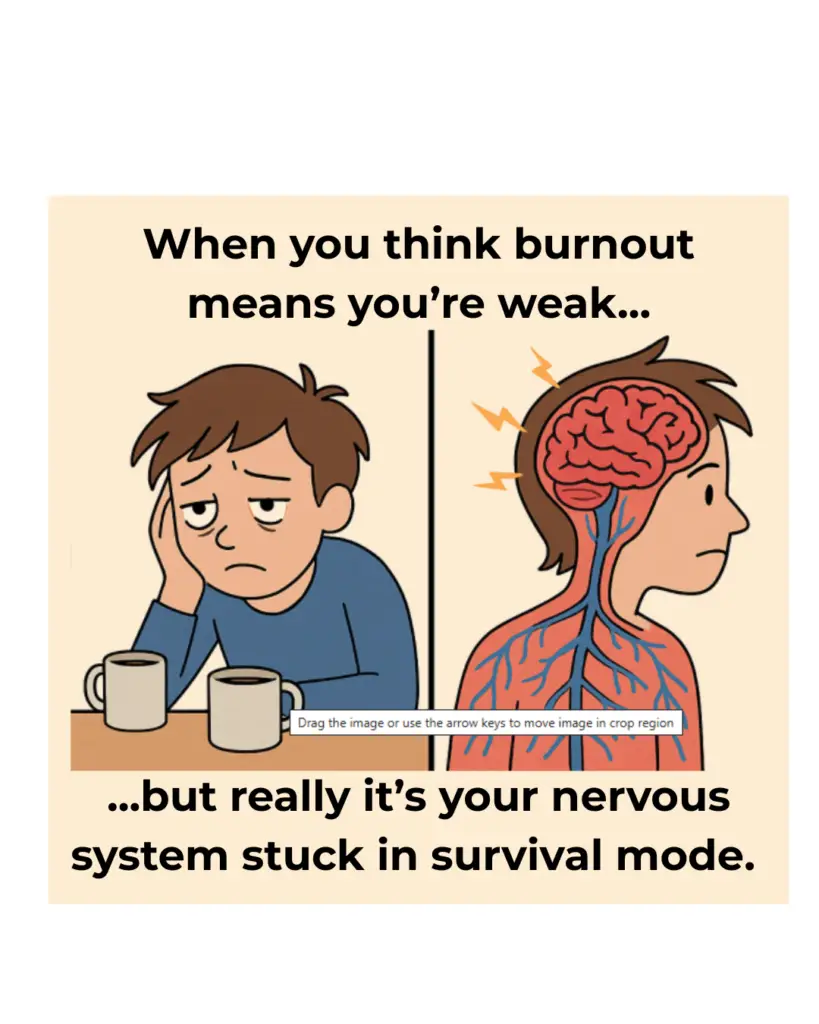
Burnout and the Body: How Long-Term Stress Affects Our Physical Health
Burnout develops when stress continues for so long that the body and mind can no longer cope. People often think of burnout as an emotional problem, but scientific research shows that it affects the body in many important ways. Long-term stress can disturb hormones, weaken the immune system, affect the heart and blood vessels, influence metabolism and even change the structure and function of the brain.
Researchers describe this overall strain as allostatic load, which means the “wear and tear” the body experiences when it is under constant pressure (Juster et al., 2011; Konlan et al., 2022). Understanding these physical effects can help individuals and workplaces take burnout more seriously.
How Burnout Affects the Body: Overview Table
The table below summarises the main systems affected by burnout and what research shows happens inside the body.
Body System | What Changes Occur? | What the Research Shows |
Hormonal (HPA Axis) | Hormone imbalance, disrupted cortisol patterns | Cortisol levels vary across studies, but daily rhythms often become “blunted” (Danhof-Pont et al., 2011; Jonsdottir and Sjörs Dahlman, 2019) |
Immune System | Increased inflammation, altered immune cell activity | Higher inflammatory markers such as C-reactive protein; more minor infections (Adebayo et al., 2025) |
Cardiovascular System | Lower heart rate variability, higher heart rate and blood pressure | Indicates chronic stress and autonomic imbalance (Traunmüller et al., 2019) |
Metabolic System | Changes to glucose levels, cholesterol, waist circumference | Higher allostatic load, increased long-term health risk (Juster et al., 2011; Konlan et al., 2022) |
Brain Structure & Function | Reduced grey matter in emotion and decision areas; changes may improve with recovery | MRI studies show structural and functional effects of chronic stress (Abe et al., 2022; Savic et al., 2018) |
Burnout by Body System
The following sections explore each system in more detail using simple language while keeping all research evidence.
- Hormonal System: The Stress Pathway (HPA Axis)
The hypothalamic–pituitary–adrenal (HPA) axis controls the release of cortisol, one of the body’s main stress hormones. When we experience stress, cortisol rises to help the body react. But when stress continues for too long, the system can become unbalanced.
Research shows that cortisol levels in people with burnout do not follow one simple pattern. Some studies find normal levels, others find higher or lower levels (Danhof-Pont et al., 2011). This means that looking at cortisol alone cannot explain burnout.
A clearer pattern appears in how cortisol changes over the day. People with burnout often show a weaker morning rise or a reduced response to stressful situations (Jonsdottir and Sjörs Dahlman, 2019). This suggests the system becomes tired after constant activation.
Studies on allostatic load also show that some people with burnout have lower overall cortisol output, which may be the body’s way of adapting to ongoing stress (Juster et al., 2011).
- Immune System: Increased Inflammation
Long-term stress can weaken the immune system and make inflammation more likely. Research shows that people experiencing burnout often have:
- Higher levels of inflammatory markers, such as C-reactive protein (CRP)
- Changes in immune cell behaviour
- More frequent minor illnesses (Jonsdottir and Sjörs Dahlman, 2019)
A study of resident doctors found that those with high burnout had both increased inflammation and traditional cardiovascular risk factors (Adebayo et al., 2025). This means burnout does not just affect how we feel — it also affects how our bodies defend themselves.
- Cardiovascular System: Stress on the Heart and Blood Vessels
The autonomic nervous system controls heart rate, blood pressure and other automatic body functions. One way to measure its health is heart rate variability (HRV) — how much the time between heartbeats changes over the day.
People with burnout often have:
- Lower HRV, showing reduced flexibility in stress response
- Higher resting heart rate and blood pressure, signs of chronic strain (Traunmüller et al., 2019)
These changes show that burnout keeps the body in a “high-alert” state for too long. Studies of allostatic load also show worse heart and metabolic profiles among individuals with burnout (Konlan et al., 2022).
- Metabolic System: How Burnout Affects Energy, Glucose and Cholesterol
Metabolic health includes glucose levels, cholesterol, blood pressure and body shape. When stress continues, these systems can become unbalanced.
Studies show that burnout is linked to:
- Higher fasting glucose
- Less healthy cholesterol levels
- Higher allostatic load scores, showing stress across multiple systems (Juster et al., 2011)
These effects increase the risk of long-term conditions such as heart disease and type 2 diabetes (Konlan et al., 2022).
- Brain Structure and Function: Changes Linked to Long-Term Stress
Burnout affects not only the body but also the brain. Neuroimaging shows:
- Reduced grey matter in the ventromedial prefrontal cortex, insula and thalamus — areas that help with emotion, decision-making and self-awareness (Abe et al., 2022)
- Increased activity in stress-related regions, such as the amygdala (Arnsten and Shanafelt, 2021)
- Some brain changes can improve when people recover from burnout, although not all disappear fully (Savic et al., 2018)
These findings help explain why burnout affects concentration, empathy and emotional balance.
What This Means for Health
The evidence is clear: burnout has real physical effects. It increases allostatic load and disrupts multiple body systems. If burnout is not addressed, it increases the risk of:
- Hypertension
- Cardiovascular disease
- Diabetes
- Cognitive difficulties
The positive news is that some changes — especially those in the brain and hormonal system — can improve when people receive support, rest and recovery time (Savic et al., 2018). Workplaces and organisations therefore play a powerful role in preventing long-term harm.
Conclusion
Burnout is not just an emotional state. It affects hormones, the immune system, the heart and blood vessels, metabolism and the brain. While no single test can diagnose burnout, the overall pattern shows clear physical strain. Understanding these body-wide effects emphasises the importance of taking burnout seriously and responding early.
Reference List
Abe, K., Tei, S., Takahashi, H. and Fujino, J. (2022) Structural brain correlates of burnout severity in medical professionals: a voxel-based morphometric study. Neuroscience Letters, 772, 136484. Available at: https://doi.org/10.1016/j.neulet.2022.136484 (Accessed: 30 November 2025).
Adebayo, O., Kanmodi, K.K., Ogundipe, H., Nnyanzi, L.A., Alatishe, T., Ojedokun, S., Oladapo, J., Ogunsuji, O., Makinde, A.M., Udeh, C.T. and Adeoye, A.M. (2025) The relationship between burnout, cardiovascular risk factors and inflammatory markers among resident doctors in Nigeria. Discover Social Science and Health, 5, 113. Available at: https://doi.org/10.1007/s44155-025-00222-4 (Accessed: 30 November 2025).
Arnsten, A.F.T. and Shanafelt, T. (2021) Physician distress and burnout: the neurobiological perspective. Mayo Clinic Proceedings, 96(3), pp. 763–769. Available at: https://doi.org/10.1016/j.mayocp.2020.12.027 (Accessed: 30 November 2025).
Danhof-Pont, M.B., van Veen, T. and Zitman, F.G. (2011) Biomarkers in burnout: a systematic review. Journal of Psychosomatic Research, 70(6), pp. 505–524. Available at: https://doi.org/10.1016/j.jpsychores.2010.10.012 (Accessed: 30 November 2025).
Jonsdottir, I.H. and Sjörs Dahlman, A. (2019) Mechanisms in endocrinology: endocrine and immunological aspects of burnout: a narrative review. European Journal of Endocrinology, 180(3), pp. R147–R158. Available at: https://doi.org/10.1530/EJE-18-0741 (Accessed: 30 November 2025).
Juster, R.-P., Sindi, S., Marin, M.-F., Perna, A., Hashemi, A., Pruessner, J.C. and Lupien, S.J. (2011) A clinical allostatic load index is associated with burnout symptoms and hypocortisolemic profiles in healthy workers. Psychoneuroendocrinology, 36(6), pp. 797–805. Available at: https://doi.org/10.1016/j.psyneuen.2010.11.001 (Accessed: 30 November 2025).
Konlan, K.D., Asampong, E., Dako-Gyeke, P. and Glozah, F.N. (2022) Burnout and allostatic load among health workers engaged in human resource-constrained hospitals in Accra, Ghana. BMC Health Services Research, 22(1), 1163. Available at: https://doi.org/10.1186/s12913-022-08539-5 (Accessed: 30 November 2025).
Maslach, C. and Leiter, M.P. (2016) Burnout: A Brief History and an Assessment. London: Routledge.
Savic, I., Perski, A. and Osika, W. (2018) MRI shows that exhaustion syndrome due to chronic occupational stress is associated with partially reversible cerebral changes. Cerebral Cortex, 28(3), pp. 894–906. Available at: https://doi.org/10.1093/cercor/bhw413 (Accessed: 30 November 2025).
Traunmüller, C., Stefitz, R., Gaisbachgrabner, K., Hofmann, P., Roessler, A. and Schwerdtfeger, A.R. (2019) Psychophysiological concomitants of burnout: evidence for different subtypes. Journal of Psychosomatic Research, 118, pp. 41–48. Available at: https://doi.org/10.1016/j.jpsychores.2019.01.009 (Accessed: 30 November 2025).
